

Back in the day, cramming your content with keywords was the key to landing a spot at the top of Google’s search results page – those were the old days!
Table of Contents
ToggleHowever, now things have changed significantly with Google’s RankBrain which handles more than 15% of searches through AI technology, and BERT has become a key player in enhancing every English search query to grasp context and intention more effectively.
If you’re fixated much about keyword density and precise matches now, you’re engaging in an old SEO struggle with tools that are no longer effective. The current search environment values content that genuinely grasps and satisfies what individuals are truly seeking, not simply what they type in the search bar.
The transition to search has brought about a shift in the way search engines analyze queries – moving beyond basic keyword matching to grasp the underlying significance as well as the context and purpose of each search query. This shift is not merely an update; it marks an overhaul in our approach to SEO strategy.
Let’s dive in and see how semantic search is changing the SEO scene and what steps you can take to stay ahead of the game.
TL;DR: Semantic Search Rules In 2025
The SEO game has fundamentally changed. Gone are the days when stuffing your content with keywords guaranteed top Google rankings. With AI technologies like RankBrain and BERT now powering search algorithms, Google prioritizes understanding user intent and context over exact keyword matches.
Semantic search focuses on meaning, not just words. When someone searches for “apple,” modern algorithms consider whether they want the fruit, the tech company, or recipes. This shift demands content that genuinely addresses what users are actually seeking, not just what they type.
The new approach revolves around four key stages: analyzing user intent beyond keywords, mapping comprehensive content that covers topics thoroughly, building contextual connections between related ideas, and optimizing the overall user experience.
Benefits are substantial: higher-quality content creation, improved user engagement, future-proof SEO strategy, enhanced topical authority, and compatibility with voice search trends. One well-optimized semantic piece can rank for multiple related terms you never explicitly targeted.
Implementation is straightforward: conduct topic research instead of keyword research, audit existing content for depth gaps, create comprehensive authority pages, build supporting content networks, and focus on natural language that mirrors how people actually speak and think about your subjects.
Semantic optimization isn’t about abandoning keywords entirely—it’s about recognizing that keywords are just the starting point for creating content that truly serves your audience’s needs and goals.
What is Semantic Search?
Google’s semantic search represents a method in search analysis that delves into the essence and connections between words in a query rather than just focusing on exact keywords like before. Instead of scanning for particular terms on a webpage as before, semantic search algorithms now aim to understand the searcher’s purpose and provide results that fulfill their core requirements effectively.
When you search for “apple,” do you mean the fruit or the tech company or perhaps some apple recipes? Regular searches show all things with the word “apple.” Semantic search dives into your history and surroundings to figure out exactly what kind of “apple” you’re after.
Search engines can grasp synonyms and related ideas with this technology, even infer meanings not explicitly stated in the search query. For example, if you search “how to repair a leak in a faucet,” the results could include information on “fixing taps.” This is because the search engine recognizes that both phrases tackle the issue at their core.
For individuals who create content and engage in marketing activities, it is essential that the content they produce covers a range of subjects and user needs instead of merely echoing specific keywords across their content pieces.

The Significance of Semantic Search in Today's SEO Landscape
- Creating High Quality Content: Semantic search values in-depth and researched material that covers topics thoroughly. This encourages the creation of resources rather than shallow pages filled with keywords.
- Better User Experience: When you focus on improving search optimization techniques, you organically develop content that addresses inquiries and resolves practical issues. This results in increased interaction and decreased bounce rates for an user experience.
- Future-Proof SEO Approach: With the development of voice search and AI technology advancements in mind, semantic optimization plays a crucial role in ensuring that your content stays easily accessible regardless of changes in search technology.
- Building Topical Authority: Building expertise in your field involves thoroughly exploring subjects instead of just focusing on specific keywords. This approach helps establish credibility within your industry and gain the confidence of both search engines and readers.
- Natural Content Creation: Creating content for search is a more natural approach as it prioritizes assisting people over manipulating algorithms. This can result in content that feels genuine and captivating to readers.
- Broader Keyword Coverage: One comprehensive piece of content that is optimized for meaning can potentially rank for terms and expressions that were not explicitly aimed for. This widens your reach.
- Voice Search Compatibility: Semantic optimization is in tune with the way individuals vocalize their search queries. This positions your content strategically for the expanding voice search market.
- Long-Term Traffic Stability: Content that is tailored for search can lead to stable traffic over the long term. This is because it focuses on delivering value rather than taking advantage of loopholes in algorithms.
The 4 Stages of Semantic Search Optimization
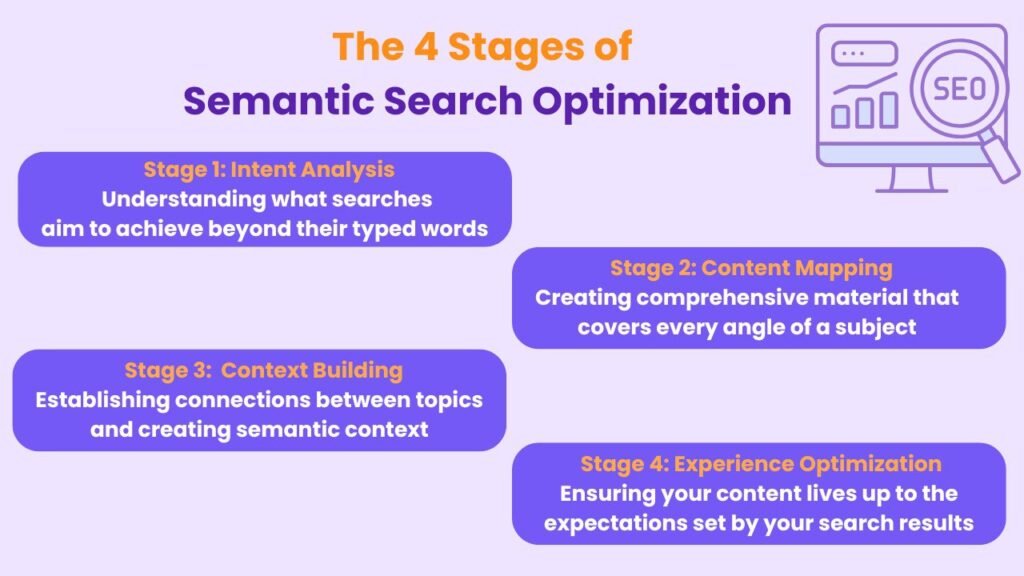
Stage 1 – Intent Analysis
Semantic search optimization is built on grasping the purpose behind search queries instead of merely focusing on the words individuals input online. In this phase of the process, you need to adopt the perspective of your target audience and delve into their needs, concerns, and objectives.
Modern search habits are quite complex nowadays as people seek things online in ways and for different reasons. For instance, when somebody types in “project management software,” their purpose could vary greatly from a freelancer seeking task organization to a startup in need of tools for team cooperation, or even an established company aiming for sophisticated workflow streamlining. It’s interesting how the same search query can hold meanings depending on the user’s situation and needs.
Action Steps:
- Classify your target queries into categories: Based on search intent – such as informational (for learning), navigational (for finding), transactional (for buying), or commercial investigation (for comparing)
- Study SERP features: Analyze the different types of search engine results page features to understand outcomes displayed by Google, including featured snippets, local packs, shopping results, and knowledge panels
- Analyze user behavior: Utilize tools such as Google Analytics and Search Console to gain insights into how individuals engage with your content and navigate through your website
- Create user journey maps: Outline the route from the point of awareness to the ultimate conversion stage, pinpointing all inquiries and worries that users may encounter
- Interview your audience: Conduct surveys or hold interviews with customers to grasp their search habits and the words they employ when seeking solutions
- Review competitor content: Assess the topics that ranking pages are addressing to understand what Google deems comprehensive for each subject area
- Utilize question research tools: Use platforms like AnswerThePublic or AlsoAsked to explore the queries people have regarding your chosen subjects
Practical Example: Sarah is a marketing consultant who aims to improve her ranking for “content marketing strategy.” Rather than focusing on that specific term as a target keyword approach, she delves deeper into understanding user intent and finds that individuals are seeking detailed implementation guides along with measurement frameworks and advice on team structure. As a result, her strategy transitions from optimizing for keywords to providing in-depth solutions to problems.
Stage 2 – Content Mapping
When crafting content maps, you establish a content framework that covers all elements of your area instead of just honing in on specific keyword objectives, aiming to furnish thorough responses to user inquiries and bolstering expertise within the realm.
When crafting your content, aim to cater to individuals exploring your subject at all levels from beginners to experts, creating a repository of information rather than standalone blog entries focused on particular keywords.
Action Steps:
- Organize your content: Create pillar topics and supporting subtopics to showcase your expertise in a hub and spoke model
- Plan comprehensive content outlines: For each subject area, compile a list of potential user questions and ensure your content addresses them thoroughly
- Build internal linking strategies: Connect relevant content pieces with contextual internal links to enhance user experience and assist search engines in comprehending relationships between topics
- Create content with varying levels of depth: Cater to different audiences—materials for beginners, comprehensive guides for intermediate users, and specialized resources for experts
- Include different types of content: Incorporate text passages with visuals like images or videos and engaging features like infographics to cater to diverse learning styles and search purposes
- Align with buyer’s journey: Ensure your content incorporates material that caters to building awareness and guiding through consideration and decision-making stages
- Develop supplemental content materials: Create checklists, templates, tools, and assets that provide benefits and promote engagement through sharing and linking
Practical Example: Tom manages a fitness blog where he consolidates information on weight loss into a comprehensive hub that covers nutrition tips and exercises while also focusing on mindset and tracking methods to create a complete resource for his readers.
Stage 3 – Context Building
Establishing connections within your content and showcasing expertise through links is crucial in building context, aiding search engines in recognizing your credibility and enhancing your content’s visibility for relevant terms.
By establishing links among ideas and employing everyday language that mirrors how individuals typically discuss and consider your subjects, you enhance the depth of meaning that search engines can readily comprehend and appreciate.
Action Steps:
- Use natural language variations: Include a variety of ways people naturally express ideas in your content by using synonyms and related terms
- Build entity relationships: Connect your content to established entities such as individuals or organizations that are familiar to Google’s knowledge graph
- Create contextual internal linking: Link related content with descriptive anchor text that clarifies the connection between different subjects
- Develop supporting evidence: Incorporate statistics, real-life examples, insights from experts, and studies that lend credibility and depth to your assertions
- Implement schema markup: Use structured data markup to assist search engines in comprehending the context and connections within your content
- Build topic-relevant external links: Link to authoritative sources in your field to show your connection with the broader topic ecosystem
- Create comprehensive resource sections: Incorporate glossaries, FAQs, and resource compilations to ensure well-rounded coverage of the topic
Practical Example: Maria’s digital marketing company produces content on “email marketing automation,” incorporating ideas such as lead nurturing and customer journey mapping organically alongside concepts like marketing funnels and CRM integration in a natural manner, with contextual links and shared language to develop a comprehensive semantic network centered around automation in marketing.
Stage 4 – Experience Optimization
Ensuring that your content is optimized for user experience goes a long way in meeting user expectations and offering value beyond just ranking high in search results. This phase emphasizes satisfaction metrics of users, which are playing a crucial role in determining search rankings.
Google regularly updates its algorithm to focus on signals related to user experience, which highlights the importance of ensuring that your content not just draws clicks but also keeps users interested and happy with their search journey.
Action Steps:
- Optimize for page experience signals: Ensure fast loading speeds, mobile-friendly design, and stable visual presentation to meet Core Web Vitals criteria
- Improve content scannability: Utilize clear headings, bullet points, brief paragraphs, and visual breaks to facilitate quick consumption of information
- Add interactive elements: Include features such as tools, calculators, or quizzes that can captivate users and offer customized benefits
- Optimize for featured snippets: Structure your content effectively to provide concise answers to targeted questions for better chances of securing featured snippet placements
- Create clear calls-to-action: Ensure your website includes prompts that nudge visitors towards actions in line with their search goals
- Monitor engagement metrics: Keep an eye on how long visitors stay on a page, bounce rates, and the path users take through your site to pinpoint areas where content could be enhanced
- Gather user feedback: Include feedback mechanisms to understand how well your content meets user needs
Practical Example: Alex’s website for software tutorials not only ranks well for technical terms but also attracts users who stay to read complete guides and bookmark valuable resources to share with others because each piece offers straightforward instructions with helpful visuals and downloadable tools that effectively address practical issues.
Advanced Semantic Search Optimization Tactics
- Entity-Based Content Strategy: Structure your content based on known entities such as individuals or brands that are familiar to Google’s Knowledge Graph. This approach assists search engines in organizing and linking your content to pertinent subjects.
- Contextual Content Clusters: Create tightly linked clusters of content where each component reinforces and mentions others. Establish expertise through in-depth coverage of topics rather than just focusing on isolated keywords.
- Natural Language Processing Optimization: Craft content that reflects the way individuals naturally discuss and consider subjects. Infuse conversational expressions along with synonyms and relevant terms that AI systems can readily comprehend.
- User Intent Layering: Create content that caters to multiple intents, enhancing the user experience by offering informational value and seamlessly encouraging users to take relevant actions when appropriate.
- Semantic Markup Implementation: Utilize structured data markup to clearly convey to search engines the significance of your content in terms of meaning and relationships. This approach assists algorithms in comprehending and organizing your information effectively.
- Cross-Topic Content Bridging: Create content that naturally links different but related topics within your field. This showcases a broad range of expertise and aids search engines in recognizing your authority across multiple subject areas.

Industry Applications
E-commerce Retailers: Product descriptions that cater to customer inquiries and needs tend to outperform listings crammed with keywords. This approach not only assists customers in locating their desired items but also enhances the visibility of related search queries.
Healthcare Providers: Healthcare professionals can enhance their information to better address patient inquiries by optimizing it for semantic search. This approach allows them to cover symptoms and treatments thoroughly while also addressing related conditions.
Financial Services: Investment guidance, loan details, and financial planning content can see improvements through semantic optimization. This is because inquiries related to finances usually consist of complex, varied questions that call for comprehensive, reliable responses.
Software Companies: Software firms excel in communicating the intricacies of their products through detailed guides and feature breakdowns. By delving into the context of user needs and offering solutions to their problems, this approach aids prospective clients in grasping not only the functionalities of the software but also how it effectively tackles their unique obstacles.
Educational Institutions: Schools and universities can attract a broader range of student inquiries by providing course descriptions and program information that cover career prospects as well as prerequisites and learning goals. This approach is more effective than focusing on narrow keyword phrases.
Real Estate Professionals: Optimizing property listings and market data for semantic search can help address buyer concerns regarding neighborhoods, schools, commutes, and lifestyle aspects that impact purchasing choices beyond basic property attributes.
Professional Services: Law firms, consulting agencies, and other service providers have the opportunity to engage clients through content that covers a wide range of client needs and inquiries instead of solely concentrating on specific service-related terms.
Future Trends:
- AI-Powered Content Generation: Advanced artificial intelligence technologies are set to play a significant role in producing content that’s rich in meaning by identifying areas where more information is needed and proposing relevant ideas. Despite this automation process advancing rapidly, human input will continue to be essential for ensuring content integrity and quality.
- Voice Search Dominance: As voice-activated helpers advance in capabilities, content tailored for natural language questions and casual search styles will hold an advantage in search rankings.
- Visual Search Integration: Improving visual search integration involves enhancing search engines’ comprehension of the connections between visual content and text. This emphasizes the growing significance of comprehensive multimedia content strategies in optimization practices.
- Personalized Semantic Understanding: Search algorithms are advancing to understand each user’s context and preferences effectively. This improvement enables the creation of content that caters to a diverse range of user needs within topics.
- Real-Time Semantic Updates: Search engines will adjust promptly to shifts in language usage and new trends. This will benefit content creators who keep up with the changing meaning of words and shifting topics in their fields.
Essential Tools for Semantic Search Optimization
Primary Research Platform: SEMrush Topic Research Tool provides comprehensive analysis of topic clusters, alongside discovering related keywords and spotting content gaps effortlessly. Furthermore, its semantic keyword research capabilities come in handy for pinpointing a range of terms and ideas associated with your subjects, facilitating the creation of thorough content strategies smoothly.
Supporting Analysis Tools: Google’s Natural Language API is useful for examining the depth of your content and identifying entities within it; AnswerThePublic shows the inquiries individuals have on subjects; MarketMuse provides recommendations for enhancing content by analyzing key competitors’ semantics.
Content Enhancement Platforms: Clearscope and Frase evaluate top-ranking content to propose enhancements and additional ideas to incorporate in your writing material, ensuring thorough coverage of topics rather than solely focusing on particular keywords.
Conclusion
The shift from emphasizing keywords to prioritizing semantic search optimization represents more than a routine algorithm update—it signifies a pivotal move towards producing truly beneficial content that addresses genuine user requirements effectively. By placing emphasis on comprehensive topic coverage, natural language usage, and user intent rather than solely targeting search engine preferences, you are not simply tailoring your content for search engines but crafting valuable resources that resonate with individuals and encourage sharing.
In the age of semantic search dominance, the companies destined for success are those that welcome the transition towards prioritizing quality, contextual relevance, and holistic value provision. Instead of resorting to tactics aimed at gaming algorithms through keyword manipulation strategies, effective modern SEO now demands a profound comprehension of your target demographic and a dedication to satisfying their entire range of informational requirements.
Initiate the process of enhancing semantic search optimization by performing a content review phase first; pinpoint your topic groupings and kick off the development of in-depth materials that showcase your proficiency in the field of interest promptly. The quicker you initiate this shift in strategy, the more robust your groundwork will become as search technologies advance towards a sophisticated comprehension of human language nuances and purposes.
